
Nature Notes November 2026
Nature Notes – November 2026
At last, it feels like autumn! There is a dampness in the air and the leaves that have not been blown off the trees by the October gales, are turning to shades of gold and bronze. The trackway leading to Booton Common was a mosaic of colour as I approached the gate. Conservation volunteers had cleared the vegetation from an area on the left as I entered, and the ponies, currently doing duty as grazers on the Site of Special Scientific Interest, had reduced the sward still further. This will in turn allow the more delicate plants for which the site is designated, to thrive next year.
As I walked across I could smell the pungent scent of Water Mint which flourishes in the damp hollows. Not quite all the flowers had gone over as there was a single mauve head of Devil’s-bit Scabious and the candyfloss-pink petals of Ragged Robin peeped out from amongst uncut grass. Looking down the wayleave under the electricity wires, the bright sun picked out the buttercup yellow leaves left on Alder Buckthorn bushes. On closer inspection, I discovered that their black berries had already been devoured by hungry thrushes. Less obvious were the deep maroon leaves of Guelder Rose, again with only a few berries left on the branches. A Holly by the path had a good crop of scarlet fruit but on a small Spindle, 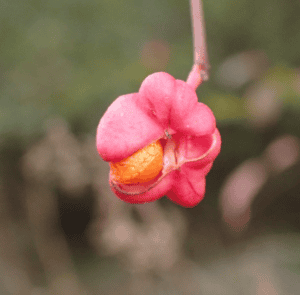 the shocking-pink seed pods were sparse with only a few orange seeds beginning to burst out of their casing. As it was still very dry underfoot, I ventured into the Alder Carr to visit the Spurge Laurel bushes that grow there. They have the misfortune of looking like small rhododendrons and are occasionally eradicated by over-zealous conservationists. They like damp shady places with some lime in the soil. Those that I found had flower buds already formed as they flower early in the year. I had hoped to find some interesting fungi as in previous years but sadly not this year. A combination of extremely hot weather and drought seems to damage the underground fungal mycelia such that very few fruit the following autumn. A solitary Hare’s-foot Inkcap, with its delicate grey cap covered in pale vertical scales as thin as a hare’s fur was all I could find. While this may seem unimportant, many fungi play an important role in the well being of woodland. The fungal threads link to tree roots, providing those trees with nutrients they could not otherwise access. Lack of these could leave the trees vulnerable to disease or extreme weather. It has been found that these threads also link trees to each other in the so-called wood-wide web. At the far end of the common there was a carpet of golden Beech leaves on the path leading to the gate where the ponies were gathered. I decided to leave them in peace and returned the way I had come, enjoying the quiet solitude.
Do let me know if you see any interesting wildlife (rachel.42rr@btinternet.com)